
002 - Helpful Articles
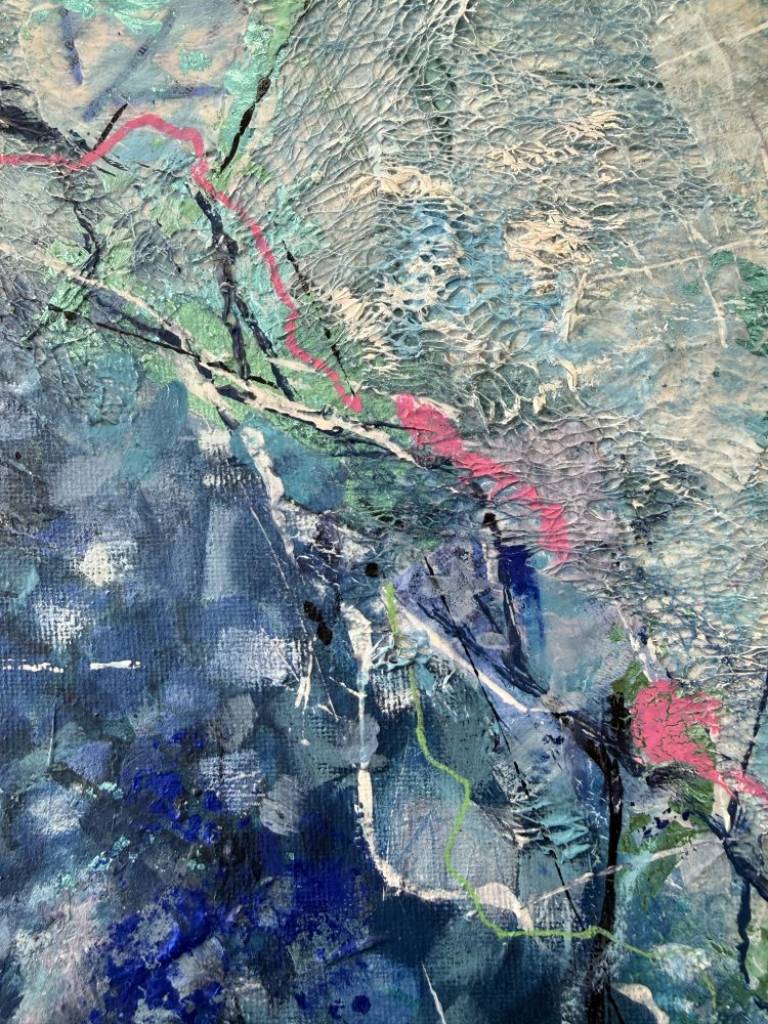
Integrating Made and Found Collage Elements into Abstract Paintings
One of the things I love most about collage is that it changes the conversation between a painting and the space around it.
Paint sits on the surface. Collage lives slightly above it.
The moment you introduce torn paper, fabric, stitched material or a found object, the painting begins to catch light differently. Tiny shadow lines appear around every edge. As daylight moves across a room, those shadows shift almost imperceptibly, giving the work a quiet sense of movement. It’s something a photograph never quite captures. You have to stand in front of the painting to experience it.
That’s why I’ve never seen collage simply as a way of adding texture.
Every material you introduce changes the rhythm of a painting. It affects where the eye settles, where it travels and how colour behaves. A painted patch of ultramarine beside a fragment of handmade blue paper may technically be the same colour, but they’ll never feel the same. One absorbs light. The other reflects it, casts a shadow and carries its own physical presence.
That difference is where the magic often begins.
Let the Material Earn Its Place
One of the easiest mistakes in mixed media is adding collage because the painting feels unfinished.
I’ve certainly done it myself.
More often than not, the painting wasn’t asking for another layer. It was asking for a better decision.
The strongest collage isn’t decoration. It solves a visual problem. Perhaps a large area needs interrupting. Perhaps a focal point needs strengthening. Perhaps the composition needs a moment of quiet tension that paint alone can’t provide.
If the collage isn’t changing the painting in a meaningful way, it probably doesn’t belong there.
Ironically, one carefully chosen fragment will usually have far more impact than half a dozen competing for attention.
Every Material Carries a Story
One of the reasons I enjoy working with found materials is that they arrive with their own history.
A weathered piece of paper, worn fabric or discarded object already contains marks made by time before it ever reaches the studio. Those marks can’t be painted convincingly because they aren’t manufactured. They’ve been lived.
Whether viewers consciously recognise that history doesn’t really matter. They feel it.
Handmade papers bring a completely different energy again. Their fibres, edges and imperfections create a subtle warmth that machine-made materials rarely possess.
The trick is choosing materials that complement the painting rather than overwhelm it.
Making Work That Lasts
Romance aside, collage is still a structural process.
If I expect a painting to last for decades, I have to think beyond today’s composition.
Acid-free papers, stable fabrics and archival adhesives are worth every penny. Newspaper, untreated wood and cheap craft glues may look fine today but can become brittle, yellow or detach over time.
Sometimes impermanence is part of an artist’s intention, and that’s perfectly valid.
Most of the time, though, collectors expect a painting to age gracefully, and I think that’s a reasonable expectation.
Building Layers
There isn’t a single right order for working.
Sometimes I attach collage first and allow paint to partially bury it. The material remains present but becomes part of the painting’s architecture rather than its subject.
Other times I build an entire painting before introducing collage near the end. The material stays visible, asserting itself as a deliberate interruption.
Both approaches work.
The important thing is allowing each layer to dry properly before introducing the next. Patience isn’t the glamorous part of painting, but it’s often the difference between work that lasts and work that begins to fail.
Knowing When to Stop
For me, this is probably the hardest lesson collage has taught.
Every additional layer has to justify itself.
If I’m reaching for another scrap of paper simply because there’s an empty space on the canvas, that’s usually my cue to put the scissors down and make a cup of tea.
Empty space isn’t failure.
It’s breathing room.
Collage is at its strongest when it works in partnership with paint rather than competing against it. The most successful mixed media paintings rarely shout about every material they’ve used. Instead, they allow each element to support the whole composition.
Like most things in painting, restraint often carries more power than excess.
The best collage doesn’t ask to be noticed first.
It asks the painting to be noticed first.
For more detailed information or if you are considering a commission, please contact me on +44 07549 756414 or by email at Tim@wlcx.art
Written: 13 July 2026
------------------------------------------------